
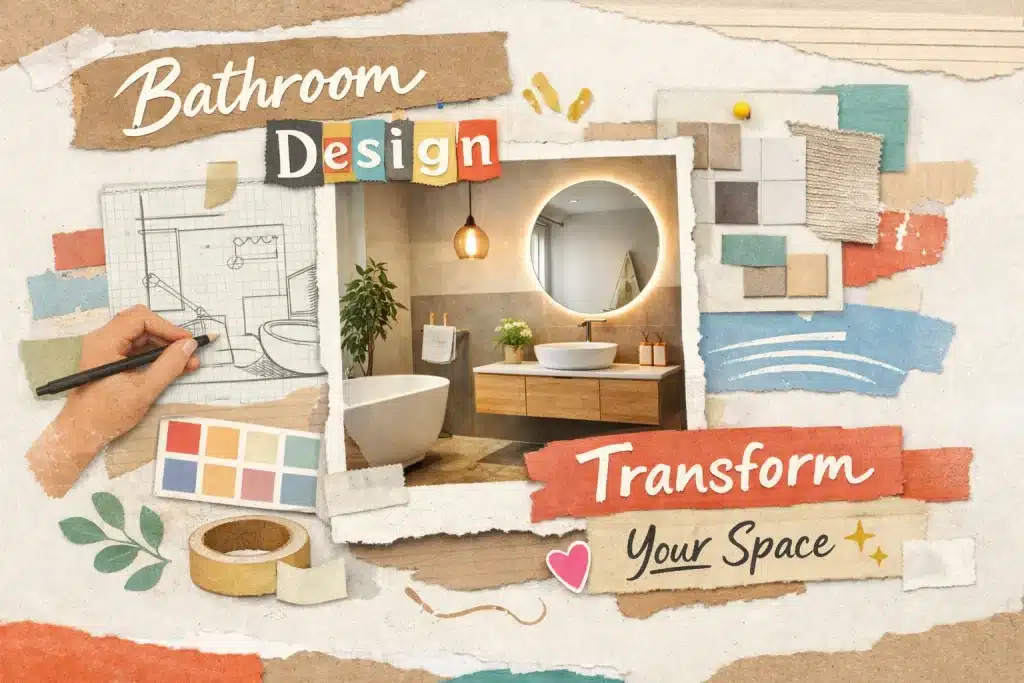
Many homeowners underestimate how much goes into a bathroom remodel until they’re standing in a half-finished room wondering why the vanity feels too big and the shower door won’t open without hitting the toilet. A professional bathroom designer exists precisely to prevent that moment. At D Marie Interiors, we work with clients who arrived at their remodel assuming it was mostly a finishes decision, only to discover that the real complexity lives in the layout, the fixture specs, and the way every surface decision feeds into the next one.
A successful bathroom transformation depends on three things working together: layout optimization, fixture selection, and visual cohesion. When all three are handled with intention, the result feels effortless. When any one is treated as an afterthought, the whole room works against you. What follows is an honest look at each, including where professional design earns its fee and where digital planning tools genuinely help.
What a Professional Bathroom Designer Actually Does
The Full Scope Goes Beyond the Surface
The common misconception is that a bathroom designer picks tile and paint colors while the contractor handles everything real. The actual job looks nothing like that. A qualified designer manages space planning, plumbing coordination, material specification, contractor communication, and budget tracking across every phase of a project. They operate as the project quarterback, translating the client’s vision into a set of documents that every trade can execute from without confusion or costly back-and-forth.
At D Marie Interiors, our scope runs from the first sketch of a layout concept all the way through finish schedule sign-off at project close. That kind of continuity matters because when one person owns the full picture, details don’t fall through the cracks between trades, something that can happen when design is treated as a free add-on rather than a dedicated discipline.
How a Designer Translates How You Live Into a Layout That Works
Before drawing a single line, a good bathroom designer asks questions most homeowners have never considered: Do you share the space with a partner every morning? Do your children need a tub or are they aging out of it? Do you need a linen closet inside the bath or can storage live in the hallway? Those answers directly shape whether the design calls for a double vanity or a long single, a soaking tub or a generous walk-in shower, or whether a niche and a recessed medicine cabinet can replace a full storage wall.
The contrast with a DIY planning approach is real. Without that discovery process, most homeowners default to what they’ve seen on renovation television or in a showroom display: a layout that looks appealing in a photograph but doesn’t actually fit how they use the space. Professional design starts with your life, then builds the room around it.
Layout Optimization: The Difference Between a Good Bathroom and a Great One
Why Floor Plan Decisions Cost More to Fix Than Finishes
Finishes are replaceable. Plumbing is not, at least not without significant expense. Moving a drain line, relocating a toilet, or adjusting a shower position after demolition routinely adds $3,000 to $5,000 or more to a project, and that’s before accounting for the schedule delays that follow. Getting the layout right during the design phase is not a luxury; it’s the most cost-effective decision in the entire project.
Most homeowners also aren’t familiar with the clearance requirements that govern bathroom layouts: minimum distances from toilet centerlines to sidewalls, door swing conflicts that create unusable space, and ADA minimums that affect resale value and long-term livability. To illustrate: we worked with one client whose layout had the shower and vanity positions swapped from the original plan. That single adjustment, made on paper before demolition, recovered three feet of dead hallway space and eliminated a door swing conflict entirely. Catching it in the design phase cost nothing. Correcting it after demo would have cost thousands.
How Professionals Solve Spatial Challenges in Small and Awkward Bathrooms
Small and oddly shaped bathrooms are where design training earns its keep most visibly. A professional reads a floor plan for traffic flow and ergonomics, not just square footage. Strategies like wet zone separation, pocket doors in tight corridors, recessed niches for storage, and floating vanities to preserve visual floor space are standard tools in a designer’s kit that rarely appear in DIY planning.
Even well-designed 3D bathroom planner apps, including popular virtual bathroom designer tools, can’t flag plumbing conflict zones or code violations automatically. They show you what the space could look like; they don’t tell you whether the drain location you’ve chosen is physically or legally buildable. That gap matters more than most homeowners realize until they’re mid-project.
Fixture Selection: Where Most DIY Projects Go Sideways
Choosing Fixtures Without Knowing the Plumbing Rough-In Is a Gamble
Fixture selection feels like a shopping task, but it’s actually a technical coordination exercise. Every fixture has rough-in dimensions: the distance from the finished wall to the center of a toilet drain, the height of supply lines for a sink, the centerline offset for a shower valve. When those specs don’t match the plumber’s rough-in work, the result is an installation problem that requires either returning the fixture or opening walls. A professional bathroom designer specifies fixtures with the plumber’s work already accounted for, not after the fact.
Trade-only product lines are another advantage that clients working with a design firm often don’t know to ask about. Many of the best fixtures, at the most competitive quality-to-price ratios, aren’t available at big box stores. They’re specified through trade relationships that a boutique firm like D Marie Interiors has built over years of project work, through manufacturer dealer programs and dedicated trade accounts. That access alone frequently offsets a portion of the design fee.
Where Personal Style and Practical Reality Meet
Finish coordination is one of the most underestimated challenges in bathroom design. Mixing metals can work beautifully when done intentionally: a matte black faucet paired with brushed nickel towel hardware as a deliberate contrast, for example. Done accidentally, the same combination reads as indecision. A designer builds a resolved finish schedule that accounts for how materials age together, how they read under the room’s specific lighting, and how they’ll look years from now, not just on installation day.
Online bathroom planner tools with built-in product catalogs can help you visualize finish combinations in a low-stakes way, and that’s genuinely useful for early ideation. The limitation is that those tools can’t confirm whether the valve trim you’ve selected is compatible with the rough-in valve your plumber already installed, or whether the drain finish you love is available in the shower system you’ve specified. That compatibility layer is where professional specification earns its value.
Style Cohesion: Why It’s Harder to Achieve Than It Looks
Visual Unity Is Built on a Material Palette, Not a Color Scheme
Style cohesion in a bathroom means every surface, texture, and finish speaks the same visual language. That’s a decision-making framework, not an instinct. It starts with the largest surfaces: the tile floor, the wall tile, the vanity finish. From there, every subsequent decision either reinforces the palette or introduces visual noise. Grout color, vanity hardware, mirror frame profile, and the color temperature of the light fixtures all feed into whether the room feels resolved or restless.
A professional builds this palette systematically: one dominant neutral, one secondary material, one accent. Within that structure, material texture, surface sheen, and scale all get deliberate attention. It’s the difference between a bathroom that looks like it was assembled from a mood board and one that looks like it was designed.
The Details That Amateurs Miss and Designers Never Skip
Lighting is the most commonly underestimated element in bathroom design. The color temperature of bulbs affects how every finish reads: a warm 2700K light makes brushed gold hardware glow and makes cool grey tile feel muddy. Task lighting positioned at face height on either side of a mirror eliminates the shadows that overhead lighting creates. Wrong lighting choices can undermine even a well-specified bathroom, and they’re difficult to correct after the room is finished.
Proportion is the other element that separates intentional design from accidental design. Tile size relative to room size, mirror scale relative to vanity width, vanity height relative to ceiling height, these relationships determine whether a room feels settled or awkward. A large-format tile in a small bathroom can make the space feel larger, but only if the grout line scale and layout pattern are handled correctly. Visual consistency is what makes a bathroom feel intentional in person, not just in photographs.
What Online Planning Tools Offer and Where They Stop
What the Best Bathroom Planners Do Well
Digital bathroom planning tools have improved substantially and serve a real purpose in the early stages of a project. Options like Planner 5D, IKEA’s free bathroom planner, and American Standard’s AR-enabled visualizer are well suited for homeowners who need to communicate a rough vision to a contractor or start narrowing down preferences before a design consultation. SmartDraw, Floorplanner, and Foyr Neo go further with measurement accuracy, exportable floor plans, and larger fixture libraries, useful when you need a printable layout or a shopping list to bring to a showroom. As a 3D bathroom designer tool or a starting-point bathroom planner app, these options give early ideation real momentum. The value is in visual communication, and that’s worth something.
What No App Can Replicate
No bathroom planner app flags plumbing rough-in conflicts, advises on material durability in high-humidity environments, coordinates with your tile installer about substrate requirements, or takes accountability if the plan doesn’t build as drawn. Those limitations aren’t criticisms of the tools; they’re simply outside what software is designed to do. D Marie Interiors brings trade relationships, project oversight, and design expertise that no app provides, and that expertise is what keeps a remodel on budget and on schedule when real-world complications arise.
The most successful bathroom remodels use both: a designer-led process with digital tools supporting the communication and visualization, not driving the decisions. Think of the app as a sketchpad, not a blueprint.
Signs It’s Time to Hire a Professional Bathroom Designer
Your Project Has at Least One of These Complexity Factors
Some bathroom projects are straightforward enough that a confident homeowner can manage them with a good contractor and clear product choices. Others cross a threshold where professional design oversight becomes the most cost-protective decision you can make. The clearest triggers include moving any plumbing, combining two rooms into one, a primary bathroom budget in the mid-range or above (often cited as a guideline around $15,000, though the right threshold depends on your market and scope), a rental or resale project where ROI needs to be protected, or an older home with non-standard rough-in dimensions that require custom specification.
Each of those factors increases the number of interdependent decisions that need to be coordinated correctly. The designer fee on a project like that typically prevents far larger downstream costs from specification errors, change orders, or a finished room that doesn’t perform the way the homeowner expected. According to industry data such as the annual Cost vs. Value report from Remodeling magazine, midrange bathroom remodels return roughly 60 to 70 percent of their cost at resale; that figure drops when poor planning leads to budget overruns or finish choices that don’t hold up.
What the Right Design Partnership Looks Like
Working with a boutique bathroom designer follows a clear path: initial consultation and space assessment, concept development with layout options, finish selection and specification, contractor coordination through construction, and project sign-off at completion. The best design relationships are collaborative throughout that process. A good designer listens first, presents options with clear rationale, and adjusts based on how you actually live, not on what’s trending in a design publication.
If the bathroom remodel has been on the list for more than a year, the bottleneck usually isn’t budget. It’s clarity. Knowing what you actually want, what’s technically feasible in your space, and what the project will realistically cost are exactly the things a professional bathroom designer provides from the first conversation. That clarity is what moves a project from the list to the schedule.
The Bottom Line on Professional Bathroom Design
The value a professional bathroom designer brings comes down to three capabilities that digital tools and guesswork can’t reliably replicate: layout intelligence that prevents expensive construction changes, fixture expertise that ensures everything installs correctly the first time, and the visual unity that makes a finished room feel deliberate rather than assembled. That combination is what protects a remodel’s value over time, and spares you from revisiting the same space sooner than you planned.
The investment in professional design typically protects the larger renovation budget by preventing the change orders, specification errors, and finish mismatches that quietly inflate project costs. At D Marie Interiors, every bathroom project starts with listening and ends with a space that works as well as it looks, which is exactly the standard a remodel of any size deserves.
If you’re ready to move your bathroom remodel from concept to plan, reach out to schedule a consultation or browse the D Marie Interiors portfolio to see what thoughtful, personalized design looks like in practice. A great bathroom isn’t just beautiful on the day it’s finished, it’s the one that still fits your life five years from now.